The History of Africa: The Cradle of Humanity and the Birthplace of Civilization

Introduction

Africa is the oldest inhabited continent on Earth and is universally recognized as the cradle of humanity. It is the birthplace of the earliest human ancestors and home to some of the world’s oldest and most influential civilizations. For millions of years, Africa has been at the centre of human history, shaping the development of civilization through remarkable achievements in science, governance, agriculture, trade, architecture, philosophy, and culture. Long before many parts of the world established organized societies, African communities had already developed sophisticated systems of governance, thriving economies, centres of learning, and vibrant cultural traditions that influenced generations across continents.

Covering more than 30 million square kilometres, Africa is the world’s second-largest continent and is home to 54 sovereign states and over 1.5 billion people. Its extraordinary diversity is reflected in more than 2,000 languages, thousands of ethnic communities, and countless cultural traditions that together form one of humanity’s richest heritages. To understand the history of Africa is to understand the story of humanity itself.

The Birthplace of Humanity

Scientific and archaeological evidence overwhelmingly confirms that humanity began in Africa. The continent has yielded some of the world’s most significant fossil discoveries, providing clear evidence of the evolution of early human ancestors over millions of years. Important discoveries in Ethiopia, Kenya, Tanzania, South Africa, and other regions have transformed our understanding of human origins.

One of the most celebrated discoveries is “Lucy,” a 3.2-million-year-old Australopithecus afarensis fossil unearthed in Ethiopia. Equally significant are the discoveries of Homo habilis, Homo erectus, and the earliest known Homo sapiens, whose remains demonstrate that modern humans first evolved in Africa before gradually migrating to other parts of the world. The Great Rift Valley, stretching from Ethiopia through East Africa, remains one of the world’s most important archaeological regions and continues to provide invaluable insights into humanity’s earliest history. Every person living today shares an ancestral connection to this remarkable continent.

The Rise of Early Civilizations

As humanity evolved, Africa also became the birthplace of some of the earliest civilizations. Along the fertile banks of the River Nile, communities learned to cultivate crops, domesticate animals, establish permanent settlements, and organize themselves into highly structured societies. These developments marked the beginning of organized civilization and laid the foundation for advances in mathematics, engineering, architecture, medicine, astronomy, and written communication.

African societies demonstrated exceptional ingenuity by developing irrigation systems, constructing monumental buildings, creating legal and administrative institutions, and fostering vibrant trade networks that connected different regions of the continent and beyond. These early achievements would influence civilizations throughout the ancient world.

Ancient Egypt: A Global Centre of Civilization

Ancient Egyptian Clothes –

South of Egypt flourished the Kingdom of Kush, centred in present-day Sudan. Kush became one of Africa’s most prosperous and influential kingdoms, distinguished by its thriving iron industry, extensive gold resources, and strategic trade routes linking Central Africa, North Africa, and the Middle East. Kushite rulers eventually conquered Egypt and established the Twenty-Fifth Dynasty, demonstrating the political and military strength of African kingdoms during the ancient world.

The city of Meroë became famous for its iron production, skilled artisans, and distinctive pyramids, which remain enduring symbols of Nubian civilization. The achievements of Kush illustrate the depth and sophistication of African societies long before the modern era.
The Great Empires of West Africa

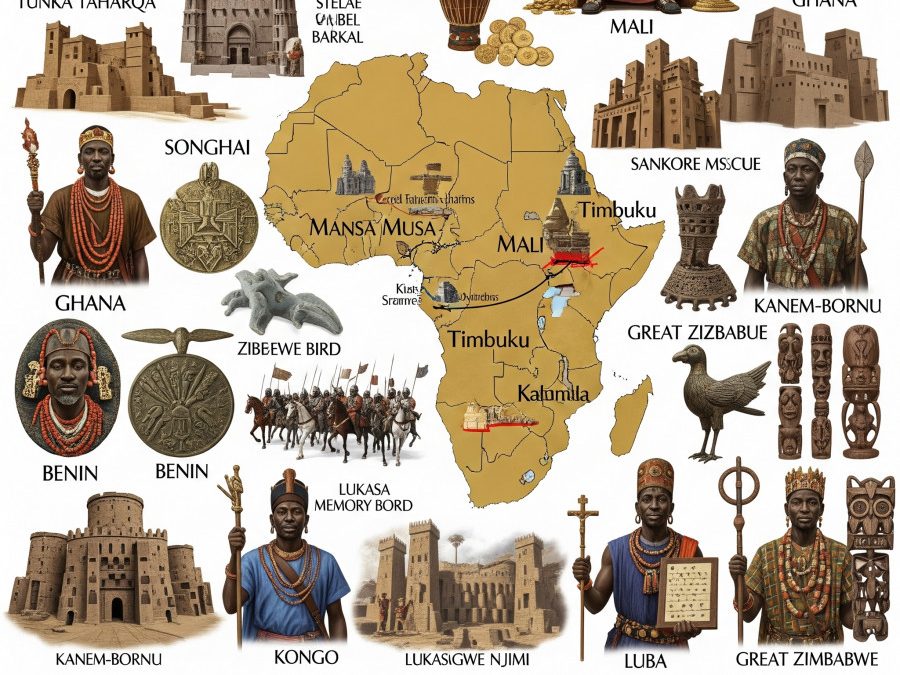
Across West Africa, powerful empires emerged that transformed regional and international commerce. The Ghana Empire established itself as a major centre of trade by controlling the movement of gold and salt across the Sahara Desert. It was succeeded by the Mali Empire, which became one of the wealthiest empires in world history.

Under the leadership of the renowned Emperor Mansa Musa, Mali gained international recognition for its immense wealth, political stability, and commitment to education and scholarship. During his historic pilgrimage to Mecca, Mansa Musa’s generosity became legendary and attracted worldwide attention to the prosperity of Africa. The city of Timbuktu flourished as one of the greatest centres of learning in the medieval world, drawing scholars, writers, scientists, and students from across Africa and beyond.

Following Mali, the Songhai Empire expanded into one of Africa’s largest and most organized states. Its efficient administration, thriving economy, and renowned centres of Islamic learning further strengthened West Africa’s position as a global centre of commerce and intellectual excellence.
East Africa and International Trade

The eastern coast of Africa developed into one of the world’s most dynamic trading regions. Prosperous city-states such as Kilwa, Mombasa, Zanzibar, Lamu, and Sofala established extensive commercial links with Arabia, Persia, India, and China. African merchants exchanged gold, ivory, spices, textiles, and other valuable commodities while also fostering cultural exchange and technological innovation.

These interactions contributed to the growth of the Swahili civilization, whose language, architecture, literature, and maritime traditions remain an important part of Africa’s cultural heritage today. The Swahili Coast demonstrates Africa’s long-standing engagement with the wider world through peaceful trade and diplomacy.

Indigenous Knowledge and Innovation

Long before the arrival of colonial powers, African societies possessed sophisticated systems of knowledge that sustained thriving communities across diverse environments. Traditional medicine, environmental conservation, metallurgy, architecture, agriculture, and astronomy were developed through centuries of careful observation and innovation. African blacksmiths mastered iron smelting techniques, farmers developed sustainable agricultural practices, and healers accumulated extensive knowledge of medicinal plants, much of which continues to contribute to modern scientific research.

Knowledge was preserved through oral traditions, storytelling, music, art, and community education, ensuring that each generation inherited the wisdom and values of its ancestors.

African Kingdoms and Systems of Governance

Africa’s history is also characterized by highly organized political institutions. Powerful kingdoms such as Benin, Buganda, Bunyoro-Kitara, Ashanti, Kongo, Ethiopia, and the Zulu Kingdom developed sophisticated systems of governance based on consultation, justice, accountability, and community participation. Kings, queens, chiefs, and councils of elders worked together to administer their societies, maintain peace, resolve disputes, and promote economic prosperity.

These institutions reflected Africa’s long tradition of responsible leadership and demonstrated that organized governance flourished across the continent centuries before European colonization.

Colonialism and the Struggle for Independence

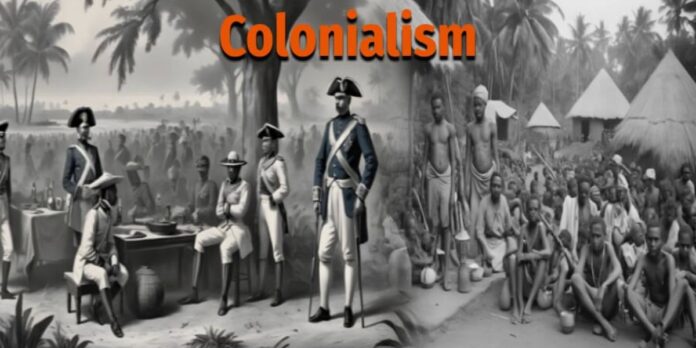
The late nineteenth century marked one of the most difficult periods in African history as European powers partitioned the continent during the Scramble for Africa. Colonial rule disrupted indigenous political systems, exploited natural resources, divided communities through artificial borders, and imposed foreign administrative structures that often ignored existing cultural and historical realities.

Despite these hardships, African peoples never abandoned their determination to achieve freedom. Across the continent, courageous men and women organized resistance movements, political campaigns, diplomatic efforts, and liberation struggles that eventually secured independence for African nations throughout the twentieth century. Leaders such as Kwame Nkrumah, Julius Nyerere, Jomo Kenyatta, Patrice Lumumba, Kenneth Kaunda, Samora Machel, Ahmed Ben Bella, and Nelson Mandela inspired millions through their commitment to justice, self-determination, and African dignity.

Pan-Africanism and the Vision of Unity

The struggle for independence gave rise to the powerful philosophy of Pan-Africanism, which advocates for the unity, solidarity, and collective progress of all people of African descent. Pan-African leaders recognized that Africa’s future depended on cooperation, shared development, and continental integration rather than division.

This vision led to the establishment of the Organization of African Unity in 1963, which later evolved into the African Union. Today, initiatives such as the African Continental Free Trade Area continue to strengthen economic integration, encourage regional cooperation, and promote sustainable development across the continent. Pan-Africanism remains a guiding principle for organizations committed to advancing Africa’s interests and empowering future generations.

Africa in the Twenty-First Century

Modern Africa is a continent of extraordinary opportunity and transformation. It possesses vast natural resources, a rapidly growing population, expanding digital economies, and one of the world’s youngest and most dynamic workforces. African entrepreneurs, scientists, engineers, artists, researchers, and innovators are making significant contributions to global development while driving technological advancement and economic growth across the continent.

Although Africa continues to face challenges related to poverty, inequality, climate change, conflict, and development, its resilience, creativity, and determination continue to inspire optimism. Increasing investments in education, infrastructure, health care, renewable energy, technology, and regional cooperation are creating new opportunities for sustainable and inclusive growth.

The Role of African Youth

The future of Africa rests in the hands of its young people. With the youngest population of any continent, Africa possesses an extraordinary demographic advantage that has the potential to transform its economic and political future. Young Africans are leading innovation, entrepreneurship, scientific discovery, civic engagement, and community development while championing peace, unity, and social justice.

The African Youth Congress believes that understanding Africa’s history is essential for building its future. By embracing the continent’s rich heritage, celebrating its achievements, and learning from its experiences, young Africans can become confident leaders committed to advancing continental integration, good governance, sustainable development, and shared prosperity.

Scroll to Top